Los Angeles
Inherent ViceLos Angeles is not merely the backdrop to Doc Sportello’s investigations but a contested landscape whose freeways, beaches, subdivisions, and police facilities make power visible in the arrangement of space. Across the city, land carries successive histories of removal: one neighborhood is cleared for another population or project, while developers and public institutions present each transformation as progress. The city’s traffic and smog bind its distant districts together, even as its history repeatedly separates people from the places they knew.
A landscape of movement and enclosure
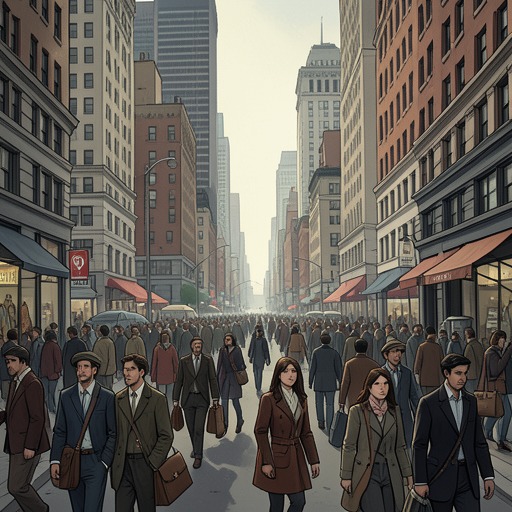
The city first appears through the movement of people and machines. At night near Gordita Beach, drinkers, surfers, dopers, and visitors from the flatlands fill the streets; beyond them, freeway traffic sends its exhaust echoes toward the sea. From the beach, the road network connects local nightlife to a wider metropolitan flow, while the oil tankers offshore make the city’s sounds seem to travel beyond its own limits.
That urban movement changes scale when Doc drives east. The freeway carries VW buses, street cars, woodies, Porsches, Cadillacs, vans, and pickups into broad fields of housing beneath transmission lines. Radios converge on the same AM stations, and the sun appears only as a probability blurred by smog. The variety of vehicles suggests a crowded public world, but the road delivers them into a landscape of repetitive development, where vast residential expanses seem to flatten distinctions even as their occupants travel together.
Los Angeles is also mapped through intimate, idiosyncratic interiors. Doc’s home is crowded with an English pub dartboard, a whorehouse-style lamp, model hot rods made from Coors cans, and a beach volleyball autographed by Wilt Chamberlain. A velvet painting of an imaginary Southern California beach offers him a substitute window when he cannot bear the ordinary one. Its palm trees, bikini-clad figures, and surfboards turn the region into an idealized image; in the shadows, especially when Doc is smoking, the painted view seems to gain a luminous edge and promise an epic night. The contrast between that private fantasy and the metropolitan landscape outside makes Los Angeles a place where the imagined California can coexist with the harder city.
Land, displacement, and redevelopment
Aunt Reet understands the metropolitan area through property at the scale of individual lots. She has an unusually comprehensive grasp of land use from the desert to the sea, including histories that deeds and contracts seldom record: family enmities, old watercourses, and the local stories attached to parcels. Her imagined future computer system would retrieve lot histories, water rights, encumbrances, and mortgages on demand, but in the present her knowledge is personal and accumulated. Through her, real estate becomes not just a market but a repository of memory and conflict.
Tariq gives that conflict a racial and historical sequence. During the Second World War, he explains, much of South Central was still a Japanese neighborhood; Japanese residents were sent to camps, and Black residents moved in afterward, treated as successors to those who had been expelled. Now, he says, his own community is being moved along. The freeway near the airport was not, in his view, the final injury. He calls the 1965 upheaval an insurrection rather than a riot, framing official labels as part of a larger struggle over who gets to name the city’s conflicts.
The novel places Tariq’s account within a longer history of clearance. Mexican families were displaced from Chavez Ravine for Dodger Stadium, American Indians were removed from Bunker Hill for the Music Center, and Tariq’s neighborhood is bulldozed for Channel View Estates. These examples make redevelopment recurrent rather than exceptional: civic and commercial projects remake valuable land by removing the communities already living on it. Aunt Reet’s knowledge of property and Tariq’s account of displacement meet in the same geography, but from sharply different positions—one can read the parcels, while the other bears the consequences of their transformation.
Channel View Estates turns that process into a landscape Doc can drive through. Signs advertise the development as “A Michael Wolfmann Concept,” and local couples come to inspect the new homes. At the edges of Doc’s windshield, Black pedestrians appear bewildered, perhaps searching for the old neighborhood and the rooms that had once seemed as stable as the axes of space. The development runs into the haze: model homes stand near the road, finished houses farther in, and unfinished construction skeletons spread toward unincorporated land. Doc parks on contractor hardpan at the future corner of Kaufman and Broad, where street signs are already installed but the streets are still unpaved.
The homes borrow the appearance of more prestigious coastal towns through Spanish Colonial styling, red-tile roofs, and small balconies, while overlooking a neglected branch of the Dominguez Flood Control Channel. Their filtered views, decorative architecture, and absence of shade trees expose the gap between the image of an established California community and the unfinished terrain beneath it. The place is at once a sales display, an expanding construction site, and the material result of a neighborhood’s removal.
Property and the powers that hold ground
Crocker Fenway describes the conflict over Channel View Estates as a battle between residential owners and developers. He presents himself as defending the environment and resisting high-density housing, but Doc answers that the issue is property values. Crocker’s reply—“It’s about being in place”—makes the deeper claim explicit. He associates lasting possession with land, water rights, oil, and cheap labor, while describing other people as transient consumers who can be bought off with a car, a bikini, a brief experience of surfing, or a chili dog.
The scene reframes the city’s real-estate argument as a contest over who can claim permanence. Crocker’s language turns accumulated control into a natural entitlement: his group has supposedly always been there, while others pass through in an inexhaustible stream. Yet the earlier histories of Chavez Ravine, Bunker Hill, and Tariq’s neighborhood show that present claims to being in place are built on earlier removals. Los Angeles’s landscape preserves this contradiction in its succession of projects: those who arrive as developers or property owners can describe their own position as permanence while the people displaced by development are cast as temporary.
The same material geography reaches into policing and administration. Doc’s memory of the Gordita Beach station’s former booking desk, hot plate, and instant coffee contrasts with its later transformation, funded by federal anti-drug money, into a lavish facility with a mini-jail, a motor pool of heavily equipped vehicles, large espresso machines, and round-the-clock pastry chefs. The station’s new resources make law enforcement part of the built environment, not simply an outside response to it. In this city, public money can change the scale and comfort of an institution as decisively as private investment changes a neighborhood.
Smog, memory, and visibility
At the end of the novel’s urban landscape, Los Angeles becomes difficult to see through at all. As Doc approaches downtown, smog thickens until he cannot see to the end of the block; headlights glow through the haze, while the sunny beach remains behind him. He has decided not to smoke much before visiting Adrian Prussia, yet a dark, metallic-gray promontory appears to rise ahead of him, large as the Rock of Gibraltar. The image recalls Sortilège’s account of Lemuria, the sunken continent returning in the lost heart of the city.
Doc wonders whether anyone would notice if the imagined continent surfaced. The people around him, he thinks, see what they have collectively agreed to see and trust accounts of the world supplied by television or newspapers. Lemuria’s possible return becomes a measure of the city’s estrangement from its own buried history: it is not only a lost place but a place from which inhabitants have been exiled for so long that they no longer remember it. The scene connects smog’s physical obstruction to a broader failure of recognition, without resolving whether the apparition is a vision or a material event.
The novel also places Los Angeles on the threshold of increasingly comprehensive surveillance. Sparky describes existing equipment as clumsy beside the fantasies of spy films and television, noting that even infrared and night vision remain far from X-ray vision. But the technology is advancing exponentially, he warns, toward a future in which people will find themselves under surveillance with nowhere left to escape. The prediction turns the city’s routes and spaces into a question of access: movement through Los Angeles may appear expansive, yet the institutions tracking that movement can narrow the space in which anyone can disappear.
Taken together, these scenes make Los Angeles a living record of unequal access to land and visibility. Its roads circulate residents and visitors through expanding housing, its developments convert displacement into a marketable image, and its institutions occupy more space and gather more capacity. Beneath the promise of California’s sunshine lies a city shaped by smog, historical erasure, and competing claims to permanence; its buried past returns in the very landscapes that redevelopment declares new.